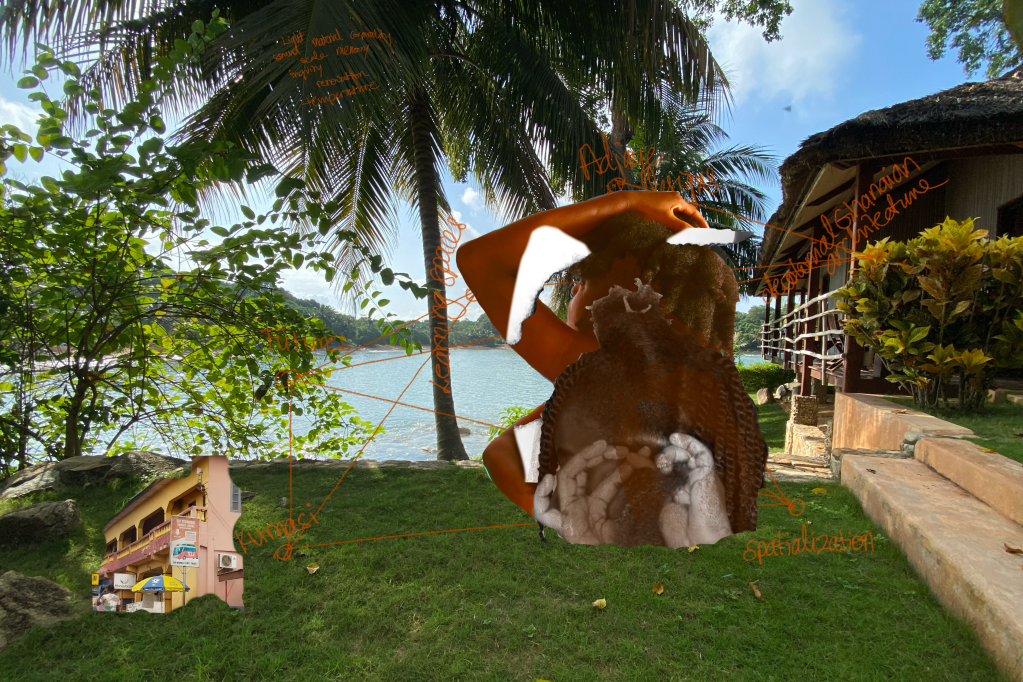
A deconstructed melange of thoughts on space and its signification.
-Space is an area of indeterminate border, a macrocosm of infinite possibility and unknown end. The idea of a space on the other hand, is carved out of the unbounded whole. It is the microcosm, that which is defined, finite, contained; created. The article itself, it would seem, separates the intimate from the public. This is the process of space-making, or spatialization.
-Buildings as a type of boundary or enclosure of space are often created to either meld into the infinite surrounding space, or to disrupt its environs.
-Creating spaces in architecture seems to me to be invested in making an innate feeling manifest. Comfort, joy, inquisitiveness. Creating the boundary between the inner and outward space, and considering everything that frames it.
-Spaces go through the process of transmutation from a conceptual space in imagination to tangible, physical reality. Architecture itself though straddles the two, at once sensorial but also decidedly physical.
-Indeed conversations around one of my many area of interests, decolonial theory, would be in remiss without mention of terminology which infers spatialization. Considerations of the Global North and South evoke the language of borders; of concepts of centre, periphery and margin; of liminality. Many of these socially constructed boundaries themselves can be used to either reinforce or oppose the Eurocentric spatial understandings with which we have made sense of the modern world.
-Spaces are rarely ever neutral. In their design and rendering, in their function, and the persisting legacy even after they fall out of use, they are still activated, charged.
At the height of the pandemic, a widely advertised exhibition at Gallery 1957 in Accra was postponed. Titled The Past is Never Dead, It was set to feature two white male artists from the UK from an architectural firm that had decided to create a “series of video, sculpture and appliqué works, some featuring the ground plans of the historic forts which bear similarity with Adinkra symbols” (Langlands & Bell-The Past Is Never Dead…, 2021). I was dismayed. While they had done some research into the design and form of these storehouses of human cargo, the gravity of it was lost on them, and rendered in stark black and white, and in cotton appliqué no less! I made it a point to endeavor to be in the white chambers of the gallery when it was to be shown and discussed. It eventually opened on the 20th of May 2021, when I was away in Cambridge.
As I expected, it was a trite reckoning of the histories of enslavement in the Gold Coast delivered by people who themselves were implicated in its history. While they alluded to the enduring legacy of colonialism in their exhibition statement, it was clear that there was no understanding of the fact that they were reentering a former British colony and centering the narrative on themselves. Correlating the harrowing edifice’s white stone walls with Akan adinkra symbols! All the while relying on the labour of local Ghanaians whose contributions were erased from the outcome. The exhibition space was not a safe space in the very country where repair was most needed. It was a distinct act of reinscribing the same imperialistic lens through their frankly offensive pieces.
It was the quintessential example of what Tuck and Yang (2012) in their seminal piece, “Decolonization is not a metaphor” speak of as “settler moves towards innocence”. While they use it in the settler colonial context, it is equally relevant in the continuing interactions between individuals from the metropole and former colony. They elaborate on this behaviour thus:
Settler moves to innocence are those strategies or positionings that attempt to relieve the settler of feelings of guilt or responsibility without giving up land or power or privilege, without having to change much at all.
(Tuck&Yang, 2012)
In fact, settler scholars may gain professional kudos or a boost in their reputations for being so sensitive or self-aware. Yet settler moves to innocence are hollow, they only serve the settler.
While I myself saw the exhibition weeks later, I was told the pushback from Ghanaians at the opening was swift, as recounted by several people who had attended. there was an immediate visceral reaction to the creation of the space itself, exponentially amplified by the gatekeepers of it. On my visit, I encountered defensive explanations as to why our histories were being related by people who despite their intimate encounters with these storehouses of human flesh, had no true conception of their horror. The space was not a sacred memorial to them, so they could tread and retread its fossilized filth without a rending of the soul. The Door of No Return though perhaps to them a sad monument, was merely a gateway to be mimicked in their video and soundscape installation, and consumed by those whose ancestors had exited through its threshold. The exhibition space was, as the Elmina castle itself, all-consuming.
In Lose Your Mother, Saidiya Hartman viscerally depicts the atrocities of the Elmina Castle. She relates in her gripping narrative voice the accumulated filth of centuries (blood, human waste, vomit, indeed flesh itself) becoming bonded to the stone and mortar of the vaulted cellars of the underground dungeon, up to eighteen inches higher than the stone construction material itself (Hartman, 2008). The excrement itself she says, is a testament to the lives of those who went before, to the “afterlife of slavery” (Hartman, 2008). All who seek to contend with these histories must understand the raw materiality of these spaces and the pain they hold.
-Anecdotes like this are why it is so vital that Africans, and people of the African diaspora have spaces they can call their own, which house their histories and hopefully futurity in a way that is befitting. Adjaye’s work on the National Museum of African American History & Culture was the first work of the firm that I encountered. It not only houses the grim histories of colonization and enslavement, but in its very design, the Yoruba inspired the crown or corona, made of bronze-coloured aluminum (so reminiscent of the expertly bronze heads and figures the Yoruba are renowned for!), the delicately rendered peripheral panels recall the African American craftmanship of New Orleans as they gently diffuse the natural light that enters the space. It is memory, texture, light, materiality at its most excellent. The museum space acts as a vehicle; drawing from the past to inform the future of a varied continent and its dispersed peoples, while creating a magnificent space in the present for cultural exchange.
-More spaces for artists to create and showcase their work, like the dot.atelier space designed by Adjaye are vital to allow Africans the agency to create and build from our own history and create revolutionary spaces that emerge from our surroundings. The textural rammed earth and steel on the three-story multipurpose space highlight the potentialities for Ghanaian architecture, sustainability, a groundedness in our very soil. Drawing from the past to make new creative futures. This work moves past simply creating a space for artistic inquiry; it creates a space for joy.
-In a very specific example of the colonial design of space, the bleak French architecture of incarceration in Senegal took into account the imperial goals of panoptic surveillance, close confinement, racial segregation of inmates, and punishment for the most trivial of offenses (Demissie, 2012,p. 184).
While I would prefer to focus on spaces that proffer joy and freedom, it must be noted that some of the architecture still in use that scars the landscape in many current African countries was directly built for the subjugation of populations. The fact that there was no architectural design or thought given to the places where people were being held for crimes against the crown itself indicates how little thought was given to those who were deemed below regard. No need to expend design potential on those whom it would be wasted. Like the dungeons of the slave forts of the Ghanaian coast before them, these early prisons were not meant to be places where their captives imagined new futures. They were desolate white houses of despair.
-The frame of a building is just that; a frame; a body, corporeal. Its mass, complete construction and function combine to form something which reads not just as anatomical. It is almost spiritual in its assemblage. A space has the unique ability to elicit our embodied understanding of aesthesis; our emotional sensibilities (Mignolo & Vazquez, 2013). Architectural spaces, like fine art, move us.
-Peter Zumthor in his seminal book Atmospheres breaks space down into components which he considers in turn. He invites a consideration of the various components that arouse our sense of a space. I consider a few of his, and several of my own:
Light and the positioning of windows. There is seldom an element that affects the feeling of a space as much as light. Walking through my own spaces of dwelling in Ghana, with the wall to ceiling windows of my parents’ home or the west facing sliding glass doors that let in the golden light of sunset it is probably the element I miss most while in Cambridge.
The temperature. Dispensing of talk of air-conditioning and heating the more obvious ways to control internal temperature, bioclimatic architecture considers the ways in which design can take into account the local climate and design accordingly for thermal comfort while making the most of sustainable resources (Guedes & Cantuaria, 2019).
Smell. The sense most closely associated with memory. Indeed, inhabiting the spaces that trigger memory make one hypersensitive to the components which bring said recollection to the fore. Material is key in rendering this sense.
The sounds of spaces draw us towards wonder. Whether the percussive tone of a wooden interior, reminiscent of the striking of a fontomfrom drum, or the acoustics of a glass dome.
Material. The use of rammed earth, bamboo, sustainably sourced hardwood timber, metal, concrete and cement all lend varied feels to a space, making it feel heavy or light, changing the temperature, occluding light or allowing it in. Texture is highly involved here, the dialogic interaction of our sense of touch and even sight with the materials we directly encounter. The exfoliated granite walls and towers of Great Zimbabwe, the smooth clay of Ife, each lending inspiration from the ancient past to the new African architects of today.
We are very aware that over the years the importation of materials and building processes have made building in Ghana and other African countries rather unsuited for the climate and conditions, and often the use of materials that are inferior rather than the naturally-occurring materials and traditional methods that are actually more ecologically friendly, and often more durable. The openness to use these types of materials and methods requires a revision of our Eurocentric thinking, which has biased many of us into thinking that “West is best.” Reclaiming what is past in its exact form is impossible, we cannot download ancient understandings of construction and design. However, it is possible to reimagine the future with the historical knowledge we can glean, from art and artefact, from a grandfather’s recollection, or a mother’s suggestion.
-Space as I have often thought of it often leans into the consideration of it as an active rather than passive form, akin to the conceptualization of Marchart, who refers to space itself as functioning as a social actor in its own right (Marchart, 2002). If social actor, then it is imbibed with an agency to construct and deconstruct the ways in which society functions around itself. By considering the ways in which space functions in our society, we can correct the ways in which it might be exclusionary/ hierarchical, and design in ways that are more inclusive, and embracing of values which are natural to our context.
-This has never been so evident to me as in recalling my childhood growing up in Kumasi; just freshly moved from our modest student apartment in suburbs of Chicago to a charming bungalow in Patase with long stretches of dark, low corridors and oddly placed fluorescent lightning which lit up the textured off-white walls. I recalled a whispered tale of it being haunted, standing so long without inhabitants, more likely its seven bedrooms an unneeded luxury for most families to rent. It was both intimate and sprawling, punctuated with four courtyards that frantically opened outward to the bright blue skies interspersed; cumulus and cirrius entwined.
My parents started their school in this space. Seven children in our living room now turned library, textured walls now browner, rubbed by a little hand as the other clung to a brightly illustrated book, small mouths sounding out the words which reverberated over the sound of the air-conditioner’s whir. It grew, and the space became too small for its new inhabitants, the ones that left at the end of the day while we remained to love the empty halls they left behind. The next year, in 1999 it was a carefully considered conversion, knocking down walls, careful to avoid the load bearing ones, reinforcing, relighting, expanding into the terrazzo veranda. Converting a living space into a fully functional multipurpose learning space. The preschool remained there when they moved to the twenty-acre campus on the fringes of town, forever haunted by the tapping little feet of eager children.
-While there has rightfully been much talk about taking up space as black people, I think that there must also be an emphasis on the creation of space, space in its every facet and conception, intangible and tangible, speculative and concrete. I might need to write a follow-up on conceptual and digital space. Another time.

 Debbie Yeboah